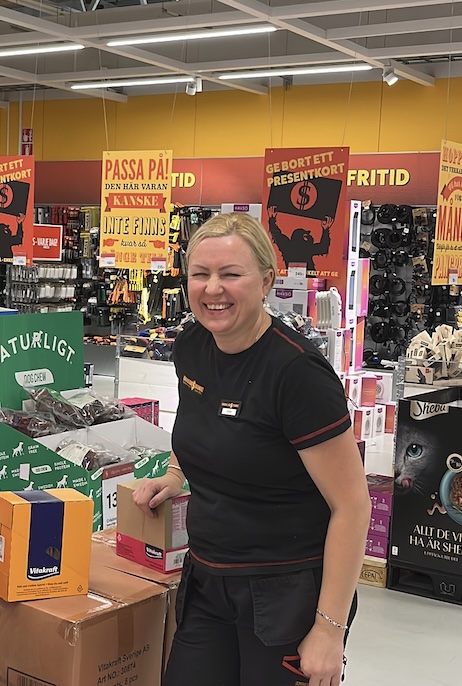
Founded by entrepreneur Peter Ahlberg in 1994, the Swedish discount retail chain Dollarstore has been part of the Finnish Tokmanni Group since 2023, doubling net sales every four years and growing from 132 to 150 stores since the acquisition, a 13.6% store expansion in just over two years. All of that while opening 4,000 m² formats, launching new store concepts, expanding private label, and operating across three countries under two brands (Dollarstore/Big Dollar).
Bringing HQ strategy into frontline reality is never easy, but with this level of complexity, involving multi-format, multi-language, generational, and cultural diversity, getting everyone on the same page is business-critical. What started as a communication problem at Dollarstore became a competitive one: how do you make a fast-growing, multi-country store network execute as one? The answer wasn't a better communications tool. It was an operating layer that brings strategy to the shop floor in one click and that, over time, becomes the kind of advantage competitors can't easily copy.
Information everywhere, findable nowhere
When we first partnered with Dollarstore, we heard a story common to many growing retailers: critical business information circulating in the void, and managers spending hours coordinating with their teams, losing precious time chasing rather than leading, in the backroom instead of in front of clients.
"Everyone was shooting out information all over the place, and no one ever found whatever was sent out."
Lena Rifve, Head of Operations
One source of truth, one place to come together
Together, we built a single hub that brings together Dollarstore’s HQ and frontline teams into one structure. Information flows at speed, is accessible to everyone on the team, and lets people execute with confidence.
"If we have to do something very fast, we just put it in Relesys. Everybody sees it right away. Even if you're at home, you can see what's happening."
Sulejman Culum, Store Manager
How work runs on the shop floor
The team now uses the app for three things that turn day-to-day operations into a structural advantage: planning labor, selling on the floor, and owning work. Each is an operational gain in its own right. Together, they're what turns communication into an operational moat.
1. Planning work with the Activity Calendar
Overstaffing on the shop floor costs money, creates confusion, and drags down team motivation. At Dollarstore, an activity calendar is used to predict work and determine who needs to be working, keeping operations effective and the team prepared to play at their best.
"You can see several weeks ahead what's going to happen every day. So you can plan, have the right number of people, and save money."
Sulejman Culum, Store Manager
2. Selling better during campaigns
If you’ve been to any shop as a customer, you know how much patience you have for people trying to figure out how to help you find items, prices, or navigate sales. With a dedicated campaign module, Dollarstore floor staff pull up the campaign sheet mid-conversation without pretending, fumbling, or walking away to check. If the customer wants a specific item which was advertised Everyone wins: the customers get a better service, teams feel equipped to do their jobs, and the business wins more sales.
3. Ownership and accountability powered up
Getting all information in one place is surely great, but it only solves half of the problem. If information goes to everyone, it goes to no one at all. With targeted tasks, employees can take ownership and be accountable, bringing clarity and faster resolution, and compounding knowledge across all levels of the business.
The network effect, a compounding payoff
Peer-to-peer problem-solving is now the standard at Dollarstore. Store managers are seeing each other's solutions before calling HQ. The platform gets smarter as more people use it, and HQ and store managers support load drops.
This is the part competitors can't shortcut. A campaign module can be built. A calendar can be copied. But a network of 150 stores where managers solve each other's problems before HQ even hears about them takes years of consistent adoption, and the advantage grows with every store that joins in.
Asking for help, recognizing one another, and celebrating milestones as one are just some of the things that are now integrated into the frontline daily routine. When all these elements come together, Dollarstore can celebrate its culture and promote belonging on a larger scale, which in turn drives stronger employee retention.
"The app is easy for the older and for the younger to work with. It makes everyone engaged and involved. It's awesome!"
Lena Rifve, Head of Operations
When we asked Sulejman what advice he'd give other store managers considering the platform, he didn't talk about features. He talked about adoption:
"Many times when I have an issue, instead of calling someone at headquarters, I see someone else already solved it."
Sulejman Culum, Store Manager
That's the shift. Not a tool that replaces email. An operating layer that turns a network of stores into a system that learns and gets better and harder to copy the longer it runs.

.webp)